At Brookmill Centre, our approach to treating dyslexia and learning difficulties is built on a simple principle: the eyes and the brain must work in sync for reading and learning to happen effectively.
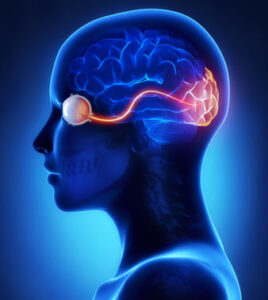
The visual cortex, at the back of the brain in the occipital lobe, is where this process centers. This area can be identified anatomically near the calcarine fissure, marked by a distinct band of tissue called the stria of Gennari. Its cellular makeup is densely packed with granular cells, structured in layers that process visual information at increasing levels of detail.
We describe this structure using a simple image: a seven-layer cake, with the eye acting as the camera that captures what we see. Our treatment tool, the Lawson Anti-Suppression Device (LASD), is designed to work with this layered structure directly — larger discs engage the upper layers of the visual cortex, while progressively finer bands reach down into its deepest layer, giving a thorough, targeted stimulation of the visual pathway.
Once the image is captured by the eye, it travels to the occipital region for initial processing, then on to the frontal lobe, where it’s actually interpreted and understood. For this whole system to function well, both eyes need steady, coordinated fixation on the same point — true binocular fixation.
In many people with dyslexia and related learning difficulties, this is exactly where things go wrong. One eye’s macula — the part of the retina responsible for sharp, central focus — often can’t hold a fixation point steadily. It may briefly achieve clarity, but that clarity slips away. As fixation falters, so does concentration, and the brain compensates by suppressing input from the underperforming eye altogether. This suppression is, in our view, a central driver of the learning struggles that follow.
By directly retraining fixation and reversing this suppression, the LASD-based program addresses the root cause rather than working around it — which is why our results are lasting, without the need for ongoing exercises or aids once treatment is complete.